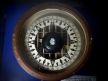
Tucked away in a corner of the Tel Aviv museum that celebrates Israel’s founding fighters is the latest addition to a small collection of artifacts. It is not part of the standard audiovisual tour, so most visitors will likely miss it. But it is probably the closest they will ever physically get to what was once hailed as “the ship that launched a nation.”
After more than 70 years, the compass from the Exodus 1947 – the storied ship full of Holocaust survivors that was intercepted by British forces on its way to Mandatory Palestine – is back home, so to speak.
It was put on display last summer at the Palmach Museum, which commemorates the elite fighting force of the Jewish underground army in the pre-state years. According to museum director Shiri Erlich, it is “to the best of our knowledge” the only surviving relic of the iconic ship that inspired Leon Uris‘ bestselling 1958 novel and Otto Preminger’s epic film two years later.
Indeed, the story of the return voyage of this sole remaining artifact provides a fitting epilogue to a dramatic episode in 20th-century Jewish history, which many believe helped swing international public opinion in favor of creating the State of Israel.
In January 1947, the Exodus set sail from France to British Mandatory Palestine with more than 4,500 passengers on board, most of them Holocaust survivors. As it approached the coast, British destroyers intercepted the ship and towed it to the northern port of Haifa, where the passengers were ordered to disembark and board other naval vessels headed back to Europe. In their desperate attempts to resist the British takeover, a Jewish crew member and two passengers were killed.
Of the dozens of ships that brought Jewish refugees to Mandatory Palestine after the Holocaust, in defiance of the British ban on Jewish immigration, the Exodus was by far the biggest. The plight of its passengers – who were eventually sent back to Germany, of all places – created a groundswell of international sympathy for the Zionist cause and, it is widely believed, helped tip the vote in favor of the November 1947 UN Partition Plan, which laid the groundwork for the creation of the Jewish state.
The ship remained docked in Haifa after its passengers were sent back to Europe. Soon after the establishment of the state in May 1948, the city’s mayor proposed turning it into a floating museum that would pay tribute to the Jews who defied the British ban on immigration. That idea never panned out, though, because the Exodus was destroyed in a mysterious fire at the port in 1952.
The SS Exodus 1947 outside of Haifa Port in 1947. Fritz Cohen / GPO
Fast-forward to the summer of 2020, when Israel was in-between its first and second coronavirus lockdowns. Isaac Herzog, then serving as Jewish Agency chairman, receives a strange phone call: It is his friend David Rutstein, secretary-general of the Baha’i International Community. Rutstein reports that a member of his church, who hails from a tiny village in southwestern England, has reached out to him with an unusual request: He wants to return the compass from the Exodus – which had been in his possession for more than 70 years – to “the Jewish people,” and is in need of advice on how to do that.
Forget Paul Newman, this Italian port tells the real story of the Exodus
When Paul Newman came to Israel
What happened to the Holocaust survivors who fled for Palestine aboard an illegal ship
Herzog, like most Israelis, had assumed the compass was destroyed with the rest of the ship in the fire and was naturally startled by this new piece of information, his longtime media adviser Liron Tzach relays.
To make sure it wasn’t a hoax, Herzog asked his Baha’i interlocutor for photographs of the artifact so he could verify its authenticity with local experts. After obtaining the confirmation he sought, Herzog recruited Irit Barash, another trusted adviser, for a special assignment.
Barash was about to head off to London to assume her new position as head of the Jewish Agency delegation to the U.K. and Western Europe. Herzog requested that as soon as she was able to travel – that is, once she had completed the two-week, coronavirus-mandated quarantine – she head down to the Cornwall to retrieve the historic relic and oversee its safe transport back to Israel.
‘Silent testimony’
In late October 2020, a day after they emerged from quarantine, Irit and her husband Rami drove some 500 kilometers (310 miles) from their apartment in Finchley, north London, to St. Agnes, a village on the northern Cornish coast, to meet with Paul Profaska, who had served as the custodian of the Exodus compass for the past seven decades.
When he presented her with the box containing the precious artifact, Irit recounts, his eyes welled up with tears. Inside, wrapped in cotton, she found a dusty and rusty compass, still filled with water yet remarkably intact.
“For me, it was a silent testimony to one of the most significant chapters in the history of the Jewish people and their return to their homeland,” she says.
And here is what Irit learned during the long conversation she subsequently held with Paul, and his wife Diane, about the whereabouts of the compass since it was last put to use on the Exodus’ dramatic final voyage.
Diane and Paul Profaska presenting the Exodus compass to Irit Barash, right, at their home in Cornwall, England. Jewish Agency
Sometime between July 1947 and May 1948, John Raymond Hillier, an officer with the British engineering corps stationed in Mandatory Palestine, was wandering around the port of Haifa looking for a “souvenir” from his tour of duty to bring back home with him. He somehow stumbled upon the compass, packed it up in his bag and brought it back to England. A few years later, he gave it to his sister Rita, Paul’s mother, for safekeeping.
From the time Paul was 8 years old, it was stored in his bedroom at the family’s small farmhouse in Cornwall. Rita, who Irit describes as a woman “very sympathetic to the suffering of the Jewish people,” was familiar with the story of the Exodus and understood that she and her family had become the custodians of a historic treasure.
Years later, the family sold their farmhouse and held a garage sale to get rid of some of the clutter. One of the items sold, without Rita’s knowledge, was the Exodus compass – for 5 British pounds ($6.75). “The person who purchased it had no idea what it was,” says Irit.
When Rita realized the Exodus compass was gone, she was furious and resolved to get it back. She eventually tracked down the buyer, persuaded him to return it and gave him back his money.
Lying on her deathbed several years ago, she made one final request of her son: Promise me that you will return the compass to the Jewish people, she said, because they are its rightful owners.
Paul’s friends urged him to disregard his mother’s last wish and instead to sell it at auction. You’ll become a rich man, they told him, but he would hear nothing of it. It would have been “sinful,” he told Irit, to profit from the sale of an artifact of such historic significance.
A replica of the ship’s bell on the Exodus, also to be found at the Palmach Museum in Tel Aviv. Moti Milrod
Around-the-clock guard
With the precious cargo packed safely in the trunk of their car, Irit and Rami headed back to London. Though small, the compass was extremely heavy. Rami insisted, however, on carrying it up to their third-floor walkup rather than leave it in the car where he feared it might get stolen. “He literally collapsed when we finally made it up to our floor,” she recalls.
Before it could be sent back to Israel, the Jewish Agency needed to check that it wasn’t violating any laws by removing such an artifact from British soil. Once the required legal clearance was obtained, the compass was sent via FedEx to the Jewish Agency offices in Jerusalem, where it sat for several months while Herzog pondered what to do with it.
“It became increasingly clear that its rightful home was the Palmach Museum, since it was the Palmach that was in charge of the Exodus operation,” recounts Tzach.
Israel’s third lockdown delayed the handover, and for a period of several days – from the time the compass made its way from Jerusalem to Tel Aviv and until the Palmach Museum was in a position to give it a proper reception – it found refuge in Tzach’s Tel Aviv apartment. “I would have been scared to leave it there alone, but fortunately that wasn’t an issue because we had to work from home at the time so I was there around the clock to guard it,” he recounts.
Yossi Harel, the legendary commander of the Exodus, is widely thought to be the inspiration for Ari Ben-Canaan, the protagonist of the eponymous book (and played by Paul Newman in the film). The new exhibit at the Palmach Museum, which operates under the auspices of the Defense Ministry, was dedicated in his honor.
Paul Newman as Ari Ben-Canaan in the 1960 film “Exodus.” His character is widely thought to be based on Yossi Harel, the legendary commander of the ship. Courtesy of Collection Cinema
Right next to the glass-encased compass is a note that reads: “In memory of Yossi Harel (1918-2008), a member of the Haganah, commander of the Exodus, and one of the leaders of the Israeli intelligence community.” It adds that during the British Mandate period, Harel commanded four “illegal” immigrant ships and was responsible for bringing some 25,000 immigrants to Israel.
When the compass arrived in his office, Herzog immediately picked up the phone and called acclaimed film producer Sharon Harel, the commander’s daughter, to notify her about the find.
“For me, it was like getting regards from my father,” she reflects back on that conversation.