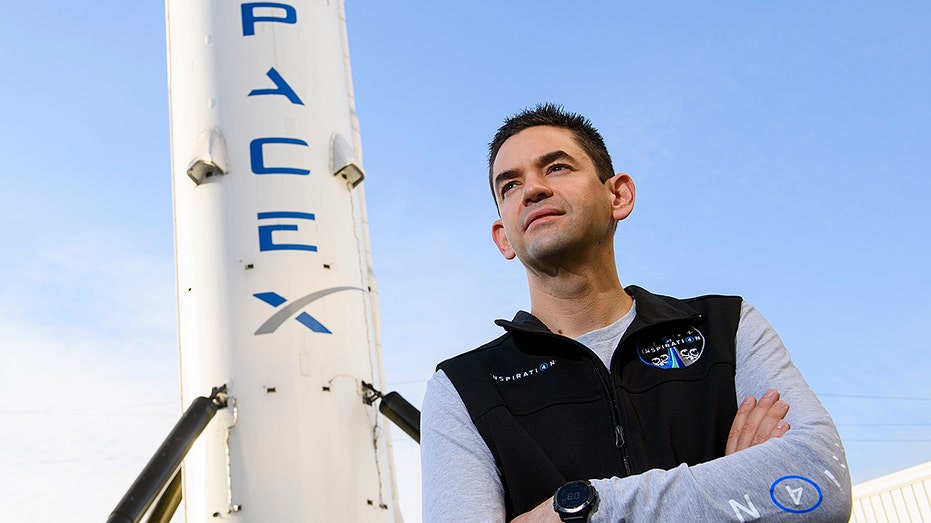
EXCLUSIVE: NASA Administrator Jared Isaacman laid out the timeline for the Artemis Moon landing and discussed the current delay to the Artemis II mission during an exclusive interview with Fox News Digital.
The agency announced Friday that Artemis III, Artemis IV and Artemis V will all be launched before the end of President Donald Trump’s second term. Artemis IV and Artemis V will be missions where astronauts return to the surface of the Moon.
“To be overwhelmingly clear, we did not stretch out our timeline or delay anything. What we did is insert additional missions, standardized, so we can actually achieve the national policy that President Trump set out to return American astronauts to the Moon, and build an enduring presence to stay,” Isaacman told Fox News Digital.
“Artemis II, we’re going to launch in a matter of weeks [and] go around the Moon,” Isaacman explained. “Artemis III will launch by mid 2027 with the aim to buy down risk and low Earth orbit for subsequent [Moon] landing attempts in 2028.”
NASA AT A CROSSROADS: TRUMP’S PLAN TO REFOCUS, EXPLORE AND BEAT CHINA
The Artemis program was initially established by President Donald Trump during his first term in December 2017.
Isaacman is seeking to complete four Artemis missions under his tenure at the agency, while the Biden administration successfully completed just one non-manned test flight in 2022.
The NASA administrator was critical of the Biden administration for the delay in launches, telling Fox News Digital “the previous administration didn’t make any decisions over the last four years that need to be done.”
“That’s being corrected now,” Isaacaman said. “You need to standardize, you need to launch with cadence. That’s how you get back to the moon. That’s how you stay. President Trump’s 100% behind that.”
Artemis II was scheduled to launch in early February, though the Space Launch System (SLS) rocket was transferred from the launchpad back to the Vehicle Assembly Building (VAB) to repair a helium leak on Wednesday.
In response to the Artemis II delay, the administrator also pointed out that the three-year delay between the Biden administration’s last successful Artemis mission and the current one set the agency back.
“You can’t launch a rocket this complex and important every three years, and expect to get it right,” Isaacman added. “There’s just, there’s just no muscle memory there. There’s going to be mistakes.”
“We’re not going to rush this, because, clearly, we’re, again, we’re relearning the same lessons, which means we didn’t get the technical root cause last time, three years ago,” Isaacman said. “We’re hoping, in a matter of days, we’ll have our arms around [Artemis II].”
Isaacman said that the current launch window for Artemis II is set for early April.
NASA RETURNS HUMANS TO DEEP SPACE AFTER OVER 50 YEARS WITH FEBRUARY ARTEMIS II MOON MISSION
The 43-year-old billionaire was sworn in as the administrator of the space agency last December. Isaacman himself is a space fanatic, having commanded the first ever commercial spacewalk in September 2024.
In the less than one hundred days that he has served as administrator, Isaacman has been vocal about his dedication to Trump’s mission to return Americans to the surface of the Moon and beyond — a daunting task for a mission that was last completed during Apollo 17 in 1972, more than half a century ago.
“The approach we were taking is the right way, and it’s consistent with NASA’s history,” Isaacman told Fox News Digital. “We didn’t go right to Apollo 11. We launched with frequency, and we continued to learn and buy down risk.”
NASA SAYS AMERICA WILL WIN ‘THE SECOND SPACE RACE’ AGAINST CHINA
“NASA, throughout our history, has launched, on average, every three months, our design vehicles from Mercury, Gemini, Apollo, through space shuttle. Apollo 8 launched less than two months after Apollo 7’s splashdown,” Isaacaman said.
“This is how you get back to the Moon and be able to stay,” the NASA administrator added.
He also noted that funding for the missions and resources needed for success already exist at the agency, and that “we got everything we need.”
TRANSPORTATION SECRETARY DUFFY TO ANNOUNCE NUCLEAR REACTOR DEVELOPMENT PLAN FOR THE MOON
One of the key components to ensuring the completion of each Artemis mission is labor, and Isaacman took issue with the large number of contractors that work with the space agency, yet are not employed by NASA itself.
When asked if he planned on transitioning contractors to NASA employees, Isaacman said, “100%.”
“One of the first observations I had in the job after visiting every one of the NASA centers is all of the core competencies that we either outsourced or lost over the years,” Isaacman explained. “Contractors are great and should contribute to NASA in areas that we are not supposed to be the best in the world at.”
“But when we’re talking about launchpad, launch control, mission control in Houston, those should be civil servants,” Isaacman told Fox News Digital. “That should be a core competency in NASA. We should be the best in the world at it. We are going to exercise the workforce directive that went out weeks ago to convert contractors to civil servants, rebuild core competencies.”
The NASA administrator said that top companies who provide contractors, like Boeing, Elon Musk’s SpaceX, and Jeff Bezos’s Blue Origin, have told him that they support the timeline that would ultimately achieve Trump’s vision of returning mankind to the Moon.
“We have universal support in this,” Isaacman explained. “Support from every one of the prime contractors in this program. Lockheed, Boeing, ULA, SpaceX, Blue Origin and all of the congressional leaders that have space equities understand that this is the way back to the Moon.”
[#item_full_content]