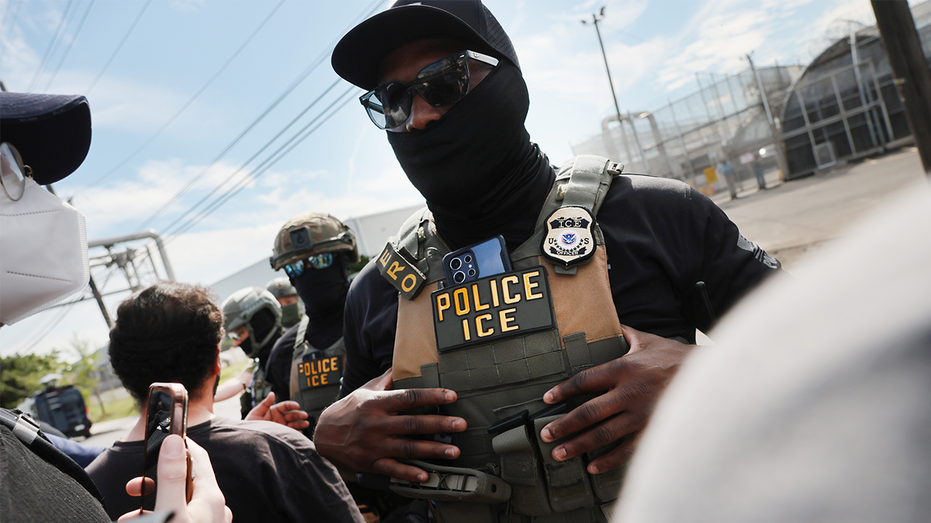
Following a week of U.S. Immigration and Customs Enforcement (ICE) vehicle stops making national headlines, a federal special agent working in deportations revealed why vehicle stops are a “very important” part of the agency’s operations.
After the second ICE officer-involved shooting in a week took place in Maine on Monday, agents nationwide were given guidance to pause vehicle stops until further notice. That guidance, however, was overruled by President Donald Trump on Wednesday, who called vehicle stops “one of ICE’s most important and effective Crime Fighting tools.”
Though controversial, the agent, who spoke on the condition of anonymity, said vehicle stops are actually the preferred tactic for many officers, because they are safer for both law enforcement and the subject than home apprehensions, and they allow more time to identify the target than street apprehensions.
Perhaps most notably, while vehicle stops have been widely criticized, the agent explained that they decrease “collateral” arrests, which they said are the apprehension of illegal immigrants who were not the target of the operation but were “at the wrong place at the right time.”
“[Vehicle stops] lead to a higher success rate in apprehending the target that they [ICE officers] are looking for and not getting the collateral. The collateral is the person that we’re not looking for, but we encounter, and they deem them as having no legal presence and/or illegal; therefore, they are going to have an admin arrest done on them.”
ICE RESUMES NATIONWIDE TRAFFIC STOPS UNDER NEW POLICY REQUIRING BODY CAMERAS
The agent said vehicle stops are a “daily” part of ICE’s operations. They described the stops as a critical “tool in the toolbox” for federal officers working on deportation operations.
Simon Hankinson, a senior research fellow on border security and immigration at the Heritage Foundation, explained that vehicle stops have become increasingly “crucial” due to growing operational risks.
“When you have to go to someone’s house, we’ve seen how difficult that can be if they don’t want you in. You need warrants, and if you’re breaking down doors, chances of somebody getting hurt are significantly higher,” he said.
“What they’re trying to do is find people and take them into custody in the calmest, quietest, safest manner possible,” Hankinson continued. “So, ideal is when local law enforcement and police presence will honor ICE detainers, and they’ll hand them over at prisons when they’re finished their sentence or their hearing or whatever it is. But when they release particularly violent criminals into the city, they will go to ground, they’ll hide, they’ll hide in places where they’re hard to find. And so, it is easier to stop them in their vehicle when they are going from A to B than it is to try to pick them up in a building with doors that are locked.”
At the same time, Hankinson called out groups using the possibility of danger in these operations to push for an end to all enforcement operations.
“They will pretend that what they really want is safety and that they just don’t want anybody getting hurt. But if you scratch the surface, you realize that’s not actually their goal. If we were able to carry out deportations in 100% perfect safety and security, they would still oppose it.”
In a social media post this week, Trump wrote, “We CANNOT give up one of ICE’s most important and effective Crime fighting tools, THE TRAFFIC STOP!”
The president reasoned that the announced DHS policy shift would be “playing right into the criminal’s [sic] hands.”
Addressing federal agents directly, he then said, “ICE, be judicious, fair and smart, and go back and do your very important job.”
The agent said that Trump’s reversal was a “huge” boost for ICE officers. The agent also noted that despite the reversal, new training on vehicle stops and how to respond to dangerous situations is already being administered to many officers operating in the field. They said that, especially given the increase in often adversarial public attention, they would “welcome” even more training for officers on vehicle stops.
“Any time you take a tool out of the toolbox, it is going to create challenges for [agents] to do their job in a more efficient way,” the agent said.
HARRIS CALLS FOR ICE PROBE AFTER MAINE SHOOTING AMID RENEWED ‘BORDER CZAR’ CRITICISM
“In other words, if I’m encountering them on a sidewalk, and they see me, and they can get in the car and leave, that’s what they’re going to do. And I don’t have any recourse, or our team will not have a recourse to go after him and stop him,” the agent said. “We’d have to hope he stops or, God forbid, he crashes into something and causes property and/or bodily harm to someone else, a third party.”
“I don’t want to hurt anyone; I really don’t,” they said. “I think any sane person would be in agreement with me to say, ‘Hey, let’s look at how we can do this safer for everybody.'”
[#item_full_content]