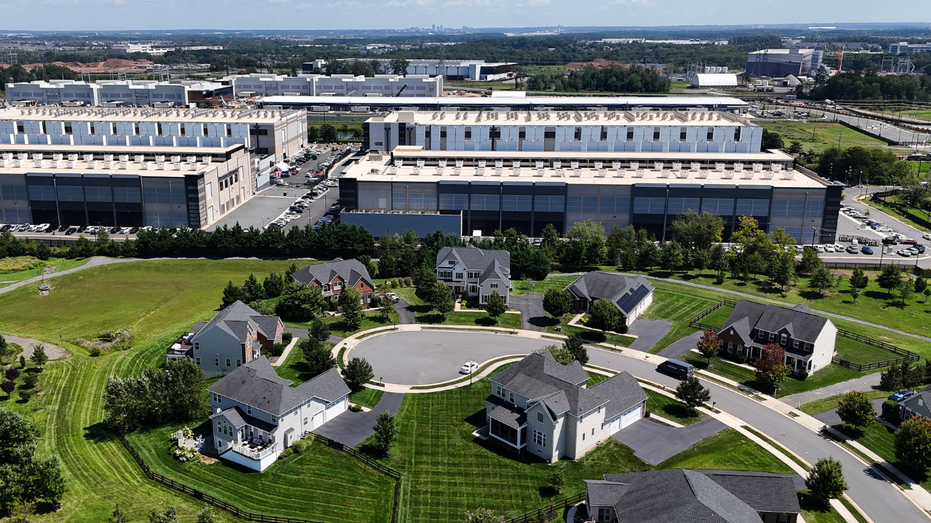
Billions in build-outs of facilities to support the artificial intelligence (AI) boom have become a lightning rod in communities across America, but homeowners in the nation’s data center capital are seeing a surprising payoff — thousands of dollars in property tax relief.
The massive projects have emerged as an issue in the 2026 midterm elections, as voters raise concerns about electricity costs, water use, land development and the strain on local infrastructure. Opposition has crossed party lines, forcing candidates to confront an industry that state and local governments spent years courting.
Yet just outside Washington, D.C., the richest U.S. enclave of Loudoun County, Virginia, offers a striking case study of the industry’s economic upside.
Home to the sprawling tech corridor known as “Data Center Alley,” Loudoun has the highest concentration of data centers in the world. Decades of development have transformed the county’s landscape and dramatically expanded its tax base, offering a real-world look at the financial benefits proponents say the industry can bring to local communities.
8 EVERYDAY THINGS THAT WOULD QUIT WORKING WITHOUT DATA CENTERS
“Loudoun County has more data centers than anywhere else in the country. It’s been sort of the capital of data center development for decades,” Jared Walczak, vice president of state projects at the Tax Foundation, told Fox News Digital.
“And because of that, Loudoun County property taxes are about half of what they would be without data centers. In fact, data centers provide about 45% of all local tax revenue to Loudoun County, not just property taxes, but all local tax revenue.”
Walczak said the impact translates into significant savings for individual homeowners.
“The average homeowner would pay $5,800 more a year in property taxes if you didn’t have data center development,” he said, noting that data centers occupy only about 3% of the county’s land.
But the rapid expansion of data centers has also fueled concerns that their enormous electricity demands could leave residents footing a higher utility bill, potentially offsetting some of those savings.
THIS TINY FARMING TOWN YOU’VE NEVER HEARD OF IS HELPING MICROSOFT SELL AMERICA ON DATA CENTERS
Walczak pushed back on that worry, arguing the industry’s impact on homeowners’ property taxes is clearer.
“The property tax relief is real, measurable and significant,” he said. “The energy costs are largely a solved problem.”
Walczak told Fox News Digital that the increased demand could require utilities to build new generation and transmission infrastructure, while adding more customers and electricity usage can also spread the grid’s fixed costs across a larger base.
The critical question, he said, is who pays for the additional infrastructure.
“You pay for the additional generation and transmission capacity. The data center pays for that,” Walczak said. “And then you actually see a slight reduction in energy costs for everyone.”
He pointed again to Northern Virginia, arguing that its experience challenges fears that a heavy concentration of data centers inevitably translates into higher electricity prices for residents.
“If you look at the places with the largest data center development, you actually see declines in energy prices relative to the rest of the country,” Walczak said. “You look at Northern Virginia, it has lower energy prices.”
As communities across the country weigh the costs and benefits of the data center boom, Walczak said Loudoun County’s experience offers a glimpse at what can happen when billions of dollars in new infrastructure become part of the local tax base.
[#item_full_content]