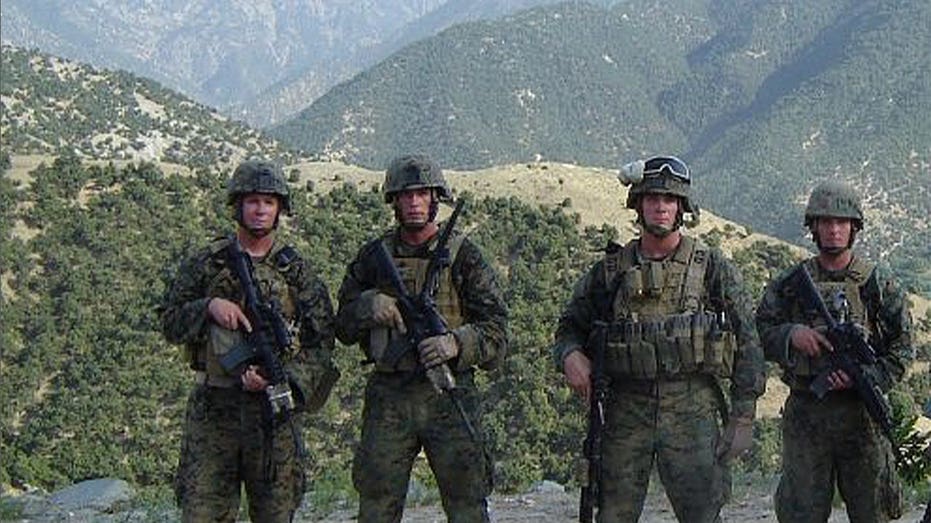
Fifteen years after Dakota Meyer left the Marine Corps, the Medal of Honor recipient decided to put the uniform back on — becoming the first with the award to ever reenlist.
Meyer was 36. He had fought in Afghanistan, struggled with the transition home from war and spent years building a life outside the military. But he said the desire to serve never went away.
“Every day after I took that uniform off, that desire to serve didn’t just end because my commitment to the country did,” Meyer told Fox News Digital in an interview ahead of Veterans Day.
AMERICAN WAR HERO DETAILS DIRE LIVING CONDITIONS US TROOPS FACE AS HEGSETH TAPS HIM TO ‘FIX’ IT
Meyer rejects the idea that receiving the Medal of Honor meant he had already done enough.
“I think sometimes it’s looked at as you’ve done your part, and I am wholeheartedly against that,” he said. “I believe that the only time you’ve done your part is when you’ve done all that you can.”
For Meyer, Veterans Day is a reminder that service does not necessarily end when someone leaves the military.
“Sometimes we look at the veteran title as it is something that represents something we’ve done,” Meyer said. “And it’s not. It’s something that we are doing, and it is something that we can continue to do.”
Meyer re-enlisted in 2025 and later entered the training pipeline to become a reconnaissance Marine, completing the grueling course in his late 30s.
“To be able to do that at 38, it was definitely one of the — hands down — probably the hardest thing that I’ve ever had to do,” Meyer said.
His first stint in the Marines had taken him to Afghanistan, where at 21 he fought in the 2009 Battle of Ganjgal in Kunar Province.
Meyer had been assigned to remain with the vehicles at a rally point while other members of his team accompanied Afghan troops toward the village roughly a mile away. The patrol was ambushed by more than 50 insurgents firing from fortified positions on the surrounding slopes.
MEDAL OF HONOR RECIPIENT JAMES CAPERS JR. SAYS RECOGNITION IS BITTERSWEET AFTER LOSING ‘SO MUCH’
Meyer and Staff Sgt. Juan Rodriguez-Chavez could hear the battle unfolding over the radio. Four members of Meyer’s team were trapped inside the ambush.
After repeatedly asking for permission to go in, Meyer and Rodriguez-Chavez drove toward the fighting, with Meyer manning the gun turret.
“I think often we try to make these decisions as if it’s some heroic decision, and it’s really not,” Meyer said. “It’s just about following through on what my promise that I had made to them.”
The pair made repeated trips into the ambush, helping evacuate wounded troops as Meyer continued searching for his teammates.
“I think it was at that point that I did realize that I just accepted that I was going to die,” Meyer recalled. “But I was gonna make sure that I would do everything I could up until that last breath.”
His four teammates were ultimately found dead. Meyer would receive the Medal of Honor for his actions that day.
Leaving the Marines the following year brought a different battle.
“I struggled. I mean, I struggled,” Meyer said. “The horrors of war definitely haunted me when I got out.”
Meyer said one of the hardest parts of returning to civilian life was figuring out what could replace the sense of purpose he had found in the military.
“The hardest part was finding purpose,” he said. “It wasn’t about being successful in anything.”
Eventually, he said, he realized that neither money nor professional success was what he was looking for. He wanted to feel that his work had an impact.
Years later, while speaking to a group of Marines at Camp Pendleton, that question of purpose came back to him in a different way.
A Marine attending a leadership course told Meyer he was deciding whether to reenlist. He had a family and could make more money outside the military, but he loved serving.
“Do you think it’s still worth serving?” he asked.
Meyer said yes, but the answer bothered him.
“I felt it was one of the most unbecoming things that I had ever said back to that crowd,” Meyer said, explaining that he was telling someone else to accept the sacrifices of continued service while he was free to return to civilian life.
“I told them that I would walk out of there and I would go about reenlisting or I would never say that to anybody again.”
It ultimately took Meyer about two years to return to the Marines.
Once back, he pursued a goal he had held since first seeing a Recon Marine poster in a recruiting office as a young man.
“They were the people that we were all trying to be inside of the Marine Corps,” Meyer said.
At 37 and 38, keeping up physically wasn’t necessarily the problem, but recovering felt different.
“What got me was the cumulative fatigue at my age,” Meyer said. “These kids can recover like nothing else.”
The experience also gave Meyer a close look at a generation of Marines nearly two decades younger than the one he had served alongside in Afghanistan.
He came away impressed.
“When we talk about service members or this next generation being weaker, it’s absolutely not the case,” Meyer said. “These kids are hands down, they will rise to the level of expectation that is set for them.”
Meyer said the Marine Corps itself has changed since he left in 2010, but he viewed much of that change as necessary. He recalled younger Marines giving him an hour-long lesson on their “new language” during a break in training and said he often found himself learning from them.
“They do things a lot smarter,” Meyer said. “I found myself learning a lot more from them than I did them probably learning from me.”
He said today’s young service members don’t have a “generational problem,” and said they still want the challenge, purpose and sense of belonging that drew those to serve before them.
[#item_full_content]