FIRST ON FOX: China’s expanding push into the Pacific Islands is raising alarms among experts, who warn that Beijing is quietly working to establish a foothold in territory long viewed as vital to American defense.
Rather than deploying troops or building overt military bases, experts say China is using infrastructure projects, political influence and economic leverage to gain access to strategically sensitive areas across Micronesia, a region tied to the United States through decades-old security agreements.
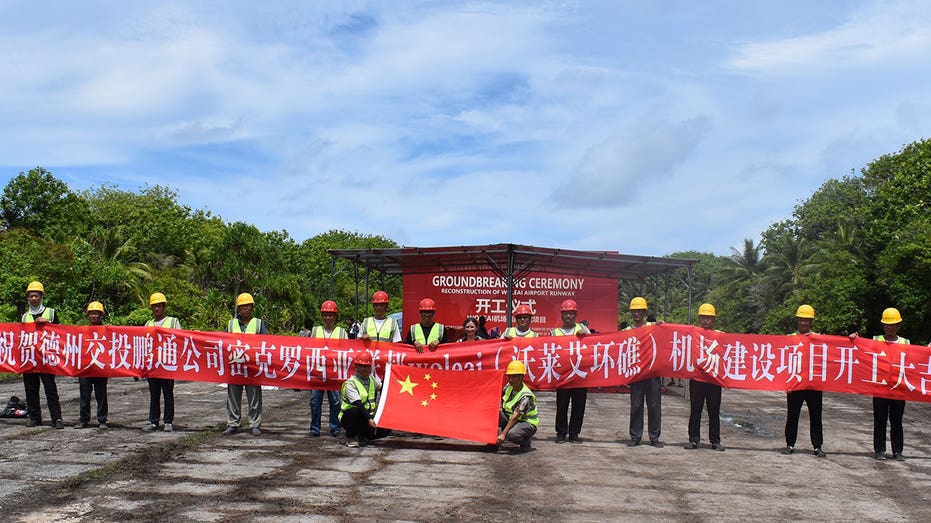
Fox News Digital has learned that a Chinese-backed runway on the island of Yap is due to be officially opened during a handover ceremony on Feb 9. The president of the Federated States of Micronesia is expected to attend, along with representatives from the Chinese company involved in the project.
One of the experts tracking the developments, FDD senior fellow Cleo Paskal, traveled to the Federated States of Micronesia to see them firsthand. She told Fox News Digital she spent four days sleeping on the open deck of a Chinese-donated cargo ship in order to witness a Chinese company breaking ground on a project to rehabilitate a World War II Imperial Japanese runway.
“It’s not a huge runway, but what it does is it gets China in the door and on the ground in a very strategic location,” Paskal said.
The project is located in the state of Yap, a remote east-to-west island chain that sits along key maritime and air routes connecting Hawaii, Guam and East Asia. U.S. military planners have long considered Yap one of the most strategically important locations in the Pacific.
Paskal said the same Chinese company involved in the runway is now working on another major infrastructure project on Yap: the reconstruction of a bridge on the main island.
“At the same time, because of how strategic it is, Secretary Hegseth announced not that long ago about $2 billion worth of defense infrastructure investment for Yap,” she said. “Now, when he says Yap, what he means is the main island of Yap.”
According to Paskal, that distinction matters.
“The story here is that the Department of War is focused on the main island, but, from what I’ve seen, there are no plans for the rest of the island chain,” she said. “Meanwhile, the Chinese are using other entry points into the political and economic system in order to start to break open access to Yap.”
She described China’s approach as fundamentally different from Washington’s.
“So it’s not just a physical kinetic infrastructure operation,” Paskal said. “It’s also a political warfare operation, whereas the U.S. is focusing more just on a very narrow band of the kinetic map.”
The geography at stake has shaped American security strategy for generations.
During World War II, the lagoon at Ulithi, part of the Yap island chain, served as the largest U.S. naval base in the world, hosting hundreds of American warships as the military prepared for operations against Imperial Japan.
That history, Paskal said, helps explain why the region remains so sensitive today.
Under the Compact of Free Association, the United States retains exclusive defense rights in Micronesia. The agreements allow Washington to deny military access to other powers, establish defense facilities and maintain strategic control, while granting Micronesian citizens the right to live and work in the United States and serve in the U.S. military. The Compact creates such deep ties that Micronesia is considered part of the U.S. domestic mail system.
The compacts were designed after World War II to ensure Pacific islands once controlled by Japan could never again be used as launch points for attacks against the United States.
But Paskal warned that China is finding ways to work around, and potentially undermine, those arrangements.
She said U.S. officials often focus on visible construction sites while underestimating the broader political campaign that enables Chinese access in the first place. This includes cultivating ties with national leaders, engaging local officials such as customs and immigration officers and securing contracts through regional development banks in order to place Chinese companies and personnel on the ground.
According to Paskal, Chinese firms are often willing to absorb financial losses in exchange for long-term strategic positioning.
CHINA QUIETLY BUILDS WORLDWIDE SPACE NETWORK, ALARMING US OVER FUTURE MILITARY POWER
The concern is heightened by political shifts within Micronesia itself. While states such as Yap have historically been more resistant to Chinese engagement, the national government has grown closer to Beijing in recent years.
Former President of the Federated States of Micronesia David Panuelo warned in a March 9, 2023, letter that China was engaging in political warfare, including alleged bribery and pressure campaigns. He later lost his re-election bid, while the current government is viewed as more receptive to China.
When asked by Fox News Digital about China’s activities in Micronesia, a spokesperson for the Chinese Embassy in Washington said, “I am not aware of the specifics.”
The spokesperson emphasized that China views Pacific Island Countries (PICs) as partners in development and denied any geopolitical intent.
“China always respects the sovereignty and territorial integrity of PICs,” the spokesperson said, adding that Beijing has “never interfered in the internal affairs of PICs, never attached any political strings, and never sought any geopolitical self-interest.”
Paskal said this characterization is not accurate, pointing to what she described as China’s targeted efforts to interfere with the internal decisions of three Pacific Island countries — Palau, the Marshall Islands and Tuvalu — to recognize Taiwan, including explicitly attaching support to derecognition.
The spokesperson’s statement added that the South Pacific should be “a stage for cooperation, rather than an arena for vicious competition” and insisted China’s engagement does not target any country.
For U.S. security experts, however, the concern is not a single runway or bridge, but the gradual erosion of strategic access in a region that has underpinned American defense for more than 80 years.
China expert Gordon Chang told Fox News Digital, “We lost so many American lives in World War Two, taking these islands from the Japanese. And now we are letting China dominate them. This is just wrong. I can’t, I get angry when I think about this. But the important point here is that we have the power to stop this,” he said.
“The three compact states are our closest military allies, our closest allies full stop. We said that again. The three complex states in the Western Pacific are our closet allies. Guam is actually part of the United States. So we have the power to stop this and we’re not doing that. And this is now on us, a strategic failure, a failure to understand what China is doing. I hope that the administration starts to understand the significance of what’s occurring and moves to block Chinese infiltration of the Western Pacific.”
As Paskal warned, China’s campaign in the Pacific is unfolding not through force, but through influence, access, patience and presence.
Neither the White House nor the Department of War responded to requests for comment from Fox News Digital.
[#item_full_content]