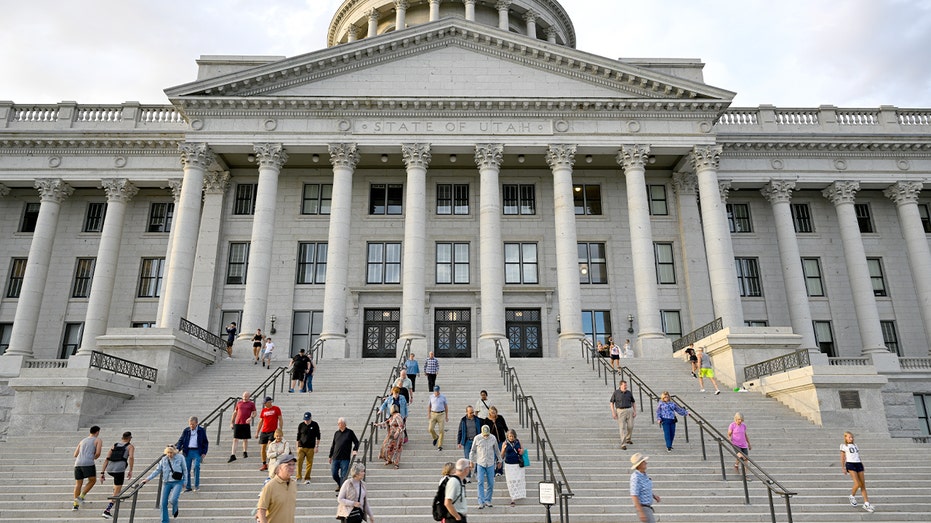
Two Republican members of Congress sued Utah’s top election official on Monday, seeking to block a court-ordered congressional map they argue was unlawfully imposed by a judge and tilts the state’s House delegation in favor of Democrats.
Reps. Celeste Maloy, R-Utah, and Burgess Owens, R-Utah, along with several other elected officials including county commissioners, filed a 31-page federal lawsuit challenging a redistricting plan known as “Map 1.”
The plaintiffs argue the map violates the U.S. Constitution’s elections clause by bypassing the state legislature, which they say holds exclusive authority to draw congressional districts.
They also contend that Judge Dianna Gibson violated the Constitution by rejecting congressional maps drawn by the Utah Legislature and imposing “Map 1,” a redistricting plan drafted by attorneys and experts for advocacy groups.
BATTLEGROUND GOP LAWMAKER MOVES TO BLOCK WHAT HE CALLS DEMOCRATIC REDISTRICTING ‘POWER GRAB’
The plaintiffs said the redistricting plan had “never been introduced, debated, or voted upon by a single member of the Utah House or Senate.”
JEFFRIES SAYS GOP ‘DONE EFF’D UP IN TEXAS,’ VOWS THEY WON’T WIN FIVE SEATS: ‘THEY CAN’T IGNORE IT’
“Map 1 was instead drafted by attorneys and expert witnesses for the League of Women Voters and Mormon Women for Ethical Government, private activist organizations that possess no lawmaking power under either the United States or Utah Constitutions,” the lawsuit reads in part.
The plaintiffs are asking the court to convene a three-judge panel, invalidate “Map 1” and permanently block its implementation, a move that would prevent its use in the 2026 elections.
They are also seeking to return redistricting authority to the Utah Legislature and, if lawmakers do not enact a new map, reinstate the state’s 2021 congressional districts.
Republicans currently control all four of Utah’s seats in the U.S. House under district lines approved by lawmakers following the 2020 census, according to The Associated Press.
The AP reported that Gibson found those districts ran afoul of voter-approved anti-gerrymandering standards and replaced them with a new map that largely keeps Salt Lake County, a Democratic stronghold, intact within a single district rather than dividing it among all four.
“This lawsuit is not an effort to control political outcomes. It is not an attempt to advantage one party or disadvantage another,” Maloy, Owens and the other plaintiffs wrote in an op-ed for Deseret News. “It is not a referendum on whether districts should be competitive or compact or on how political balance ought to be measured. Those debates belong in the Legislature, where proposals can be introduced publicly, amended openly and resolved by representatives accountable to voters.”
“We filed this federal lawsuit not because it was easy but because it was necessary. We seek no special treatment. We ask only that the U.S. Constitution be followed, that the Legislature be allowed to fulfill its lawful role under the federal Constitution and that Utahns retain their right to choose representatives through a process that is legitimate and accountable,” they added. “That is not radical. It is foundational. And it is worth defending.”
[#item_full_content]