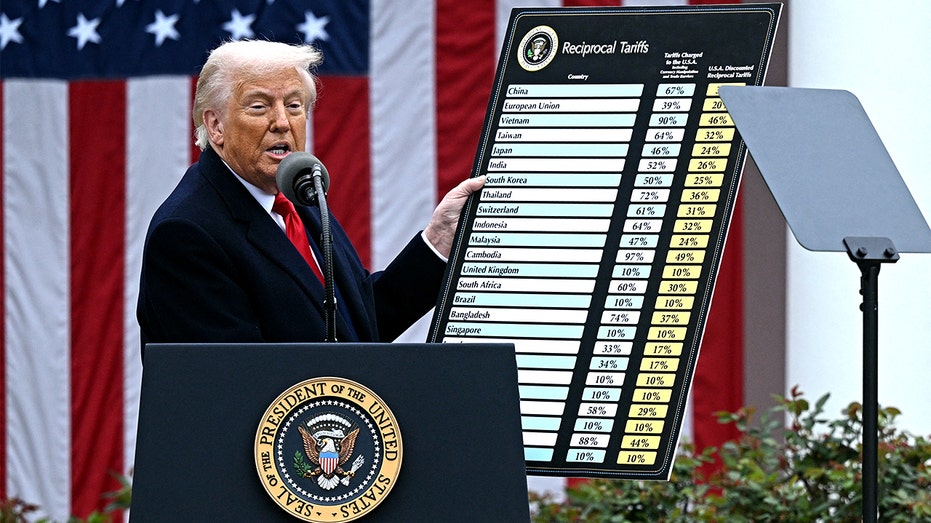
A year ago today, President Donald Trump announced a sweeping new round of global tariffs, escalating trade tensions with key allies and adversaries alike, raising fresh concerns about the outlook for the U.S. and global economy.
The “Liberation Day” tariffs were introduced as a broad set of import taxes that Trump said would correct long-standing trade imbalances and reduce U.S. reliance on foreign goods.
In the months that followed, markets experienced bouts of volatility as businesses and investors adjusted to the shifting trade landscape. Policymakers and economists, meanwhile, debated the longer-term impact on growth, inflation and global trade flows.
Many economists warned of potential consequences, including higher prices, slower growth and rising uncertainty for businesses and investors.
TRUMP SAYS US WOULD BE ‘DESTROYED’ WITHOUT TARIFF REVENUE
But not everyone agreed.
“Trump proved 12 Nobel Prize economists wrong,” economist Stephen Moore told Fox News Digital.
“Inflation didn’t rise. Why? Because the tax cuts, deregulation and ‘drill, baby, drill’ policies lowered prices and offset the tariffs,” added Moore, a former Trump adviser and co-founder of the free-market advocacy group Unleash Prosperity.
But Moore’s view was not widely shared. Here’s a look back at what other economists said at the time.
Former Treasury Secretary Larry Summers called the ‘Liberation Day’ tariffs “masochistic,” saying they were the worst levy the U.S. had imposed in decades.
“Never before has an hour of Presidential rhetoric cost so many people so much,” Summers wrote on X. “The best estimate of the loss from tariff policy is now closer to $30 trillion or $300,000 per family of four.”
Paul Krugman, a Nobel Prize–winning economist, said Trump had “gone full-on crazy” in the hours after the “Liberation Day” tariffs were announced.
“If you had any hopes that Trump would step back from the brink, this announcement, between the very high tariff rates and the complete falsehoods about what other countries do, should kill them,” Krugman, a former MIT and Princeton University professor, wrote in his Substack newsletter.
Christine Lagarde, president of the European Central Bank, warned that the tariffs would be “negative the world over,” in an interview with Ireland’s Newstalk.
She said Trump’s trade policy would weigh on global growth and carry broad consequences.
“It will not be good for the global economy, and it will not be good for those who impose the tariffs or those who retaliate,” Lagarde said.
Economist Joseph Stiglitz said Trump’s tariff threats have made the U.S. “a scary place to invest” and could unleash stagflation. Stagflation refers to a combination of slow economic growth and rising prices. Stiglitz, a Columbia University professor and former World Bank economist, warned in an interview with The Guardian that he does not see a strong economic outlook ahead.
“I cannot see a really robust economy,” said Joseph Stiglitz, former chair of President Bill Clinton’s Council of Economic Advisers. “I see the global economy suffering greatly from the uncertainty that Trump poses.”
He also said the inflation triggered by the tariffs is moving in the wrong direction and that the only thing the Trump administration will succeed in doing is “to crater the economy.”
Jared Bernstein, the former White House chief economist under President Joe Biden, said the U.S. is a “large, dominant economy” that is relatively closed, meaning it relies less on trade than most countries.
“That means, as Trump has argued, we can hurt other countries more than they can hurt us,” Bernstein said. “But he hasn’t offered a clear rationale for why we should start a trade war with traditionally reliable partners like Canada, Mexico, Japan, and Europe.”
Bernstein said Trump may reverse course if mounting economic pressures—such as higher inflation, slower growth, falling stock prices and rising recession risks—intensify from the tariffs.
“So far, that may have been the approach in Trump’s first term; it doesn’t appear to be the approach this time around,” he said.
Allianz chief economic adviser Mohamed El-Erian called for clarity from the White House. “If we get clarity on this, this is an economy that can adjust,” he told FOX Business.
El-Erian, the former CEO of bond giant PIMCO, wrote on X that “the price action in global financial markets in the immediate aftermath of the U.S. tariff announcement points to major worries about global economic growth.”
Bill Gross, the co-founder of Pacific Investment Management Co., known as Pimco, said the latest round of tariffs is “similar to going off the gold standard in 1971″—an “epic” shift that markets won’t quickly recover from.
“It’s not something where you can time a market bottom quickly,” Gross told CNBC. “It’s something we’re going to have to live with as long as President Trump maintains this stance.”
Gross, dubbed the “Bond King,” added that he does not expect Trump to reverse course. “To be very blunt, President Trump is a macho male, and this macho male is not going to back down tomorrow simply because the Nasdaq is down 5%,” he said.
[#item_full_content]