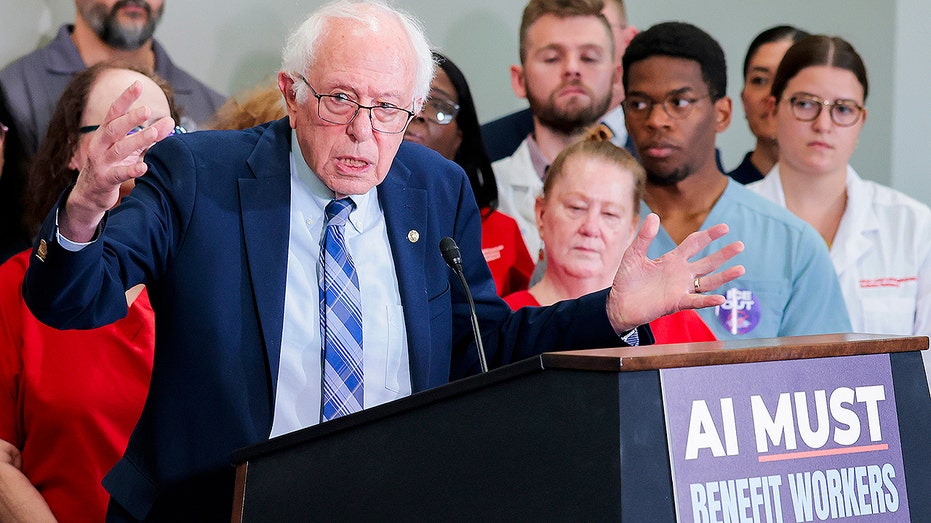
Sen. Bernie Sanders, I-Vt., is drawing scrutiny for cozying up to Chinese AI governance officials while championing policies that critics say would hamper America’s ability to compete with Beijing in the global artificial intelligence arms race.
Sanders, who caucuses with Senate Democrats and is a self-proclaimed democratic socialist, is expected to be speaking at a panel discussion on Capitol Hill Wednesday alongside Xue Lan, a professor at the CCP-funded Tsinghua University and chairman of the Ministry of Science and Technology-backed New Generation Artificial Intelligence Governance Professional Committee.
In attendance will also be Zeng Yi, who is the Dean of the Beijing Institute of AI Safety and Governance and is also tied to the New Generation Artificial Intelligence Governance Professional Committee chaired by Lan. Massachusetts Institute of Technology (MIT), Max Tegmark, who will also be speaking at the event, indicated the event will focus on “AI existential risk and international cooperation.”
Critics from the White House, the data center industry, and major tech-policy think tanks have argued Sanders is proposing policies that would slow the construction of the very infrastructure needed to keep the United States ahead in the race for AI dominance. Now, Sanders is facing more heat for holding an event on Capitol Hill with two Chinese Ministry of Science-linked officials who support China’s preferred AI governance model.
CHINA RACES AHEAD ON AI —TRUMP WARNS AMERICA CAN’T REGULATE ITSELF INTO DEFEAT
“I think Senator Sanders’ concerns about AI are overstated, but I respect them. We should be asking questions about child safety, community impact, and economic displacement,” China policy expert at the Hudson Institute, Michael Sobolik, said. “What we shouldn’t do is partner with foreign adversaries like the Chinese Communist Party in those discussions.”
Rep. Pat Harrigan, R-N.C., pointed out that Tsinghua University is “one of China’s top universities with direct ties to the Chinese Communist Party.”
“This is the same China that just blocked Meta’s $2 billion deal to acquire Manus AI, a startup whose founders had already moved to Singapore and whose deal was already done and closed. Beijing decided it did not matter. They stepped in, killed the deal, and restricted the founders from leaving the country while it was under review,” Harrigan wrote in a Monday post on X ahead of the slated panel discussion on Capitol Hill.
“China is aggressively locking down their most powerful AI assets and shutting American companies out,” he continued. “Bernie Sanders wants to hand them a seat at the table to help decide how America handles the same technology.”
“Holy sh–,” Ruthless Podcast co-host Comfortably Smug posted on X.
“It’s a bit on the nose that communist Bernie Sanders is looking to the Chinese Communist Party for their ‘leadership’ on AI,” conservative commentator Steve Guest posted on X.
Fox News Digital reached out to Sanders’ office but did not receive a response in time for publication.
In March, Sanders and Rep. Alexandria Ocasio-Cortez unveiled the Artificial Intelligence Data Center Moratorium Act, which would impose an immediate federal ban on the construction or upgrading of new AI data centers until Congress passes a broader regulatory framework. Sanders’ own office said the bill is designed to “slow down the development of AI,” and Sanders has separately argued that AI threatens jobs, privacy, democracy, the environment and “maybe the human race.”
Even Democrats have balked at the policy proposal, with Sen. Mark Warner, D-Va., calling the moratorium “idiocy” at an artificial intelligence summit in D.C. last month, warning it would give China an edge in the AI race.
Cy McNeill, the senior director of federal affairs at the Data Center Coalition, a pro-industry group, said a freeze would risk “rationing access to digital services,” impair U.S. competitiveness and hit Americans’ daily lives. The Center for Data Innovation, a tech-policy think tank, similarly argued the bill relies on “well-worn anxieties” and does not justify halting data-center construction.
US TARGETS CHINESE ROBOTS OVER SECURITY FEARS
Lan, as chair of China’s national expert committee for AI governance, and Li, who told TIME last year that he is “highly involved in policymaking through national governance committees” in China, both have championed governance models that would expand China’s role in writing global AI rules that clash with a freer, more competition-driven U.S. strategy.
Yi has argued that China and the world need mandatory safety and ethics frameworks and more international cooperation, according to comments he made to TIME. He also helped develop UNESCO’s Recommendation on the Ethics of AI, the first-ever global standard on AI ethics.
Lan, meanwhile, helped establish a CCP-backed national AI safety body to help “bridge” the gap between technical experts and policymakers, according to TIME.
“China has chosen the path of top-down government control to drive its AI industry. While this strategy affords the CCP some advantages, the American model of bottom-up, free-market capitalism has long been the engine of innovation for the world, and it is more efficient in the long run,” House Energy and Commerce Chairman Brett Guthrie wrote in a February policy review for the Hatch Center.
“The stakes couldn’t be higher,” Guthrie continues. “China already deploys next-generation technologies to advance many of the regime’s most sinister goals focused on enhancing the power of its Orwellian surveillance state utilizing advanced computing. Even more concerning to the American public is the threat of an adversary’s technology stack serving as the building blocks for future advancements or as a strategic chokehold.”
“The way to beat China in the AI race is to outrace them in innovation, not saddle AI developers with European-style regulations,” Sen. Ted Cruz, R-Texas, has also said. Growth and development of new AI technologies will bolster our national security, create new jobs, and stimulate economic growth”
[#item_full_content]