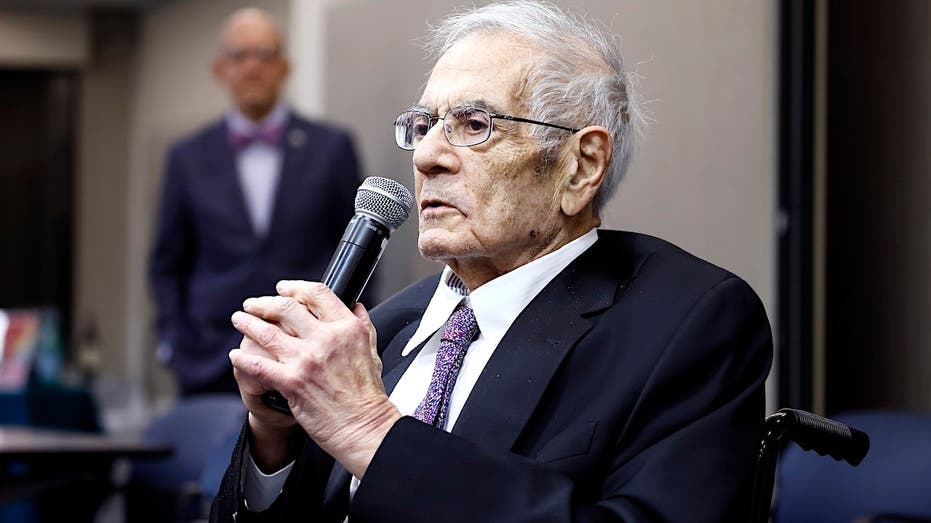
Former Rep. Barney Frank, D-Mass., whose biting wit, liberal politics and mastery of financial policy made him one of the most recognizable members of Congress for more than three decades, has died at 86.
Frank died late Tuesday, Jim Segel, Frank’s former campaign manager and close friend, confirmed to The Associated Press.
“I have been trying to decide, by the way, personally, whether it’s better to be an icon or an emoji,” Frank, with his caustic wit, told CNN’s “State of the Union” in a May 3 interview while in hospice for congestive heart failure. He disclosed before his death that his condition had left him with little energy but not much pain.
“Essentially, after 86 years, my heart’s just wearing out,” Frank, who appeared gaunt, told Jake Tapper.
Frank represented Massachusetts in the House from 1981 to 2013, serving 16 terms and becoming chairman of the House Financial Services Committee during the 2008 financial crisis. His name became attached to the Dodd-Frank Wall Street Reform and Consumer Protection Act, the sweeping 2010 law he co-authored with then-Sen. Chris Dodd, D-Conn., after the collapse of the housing market and the near-failure of the U.S. financial system.
FORMER NY DEMOCRATIC REP CHARLIE RANGEL DEAD AT 94
The law, signed by President Barack Obama on July 21, 2010, imposed new rules on major financial firms, derivatives, mortgage lending and consumer protection.
For supporters, Dodd-Frank was the most consequential financial regulatory overhaul since the New Deal, an attempt to rein in Wall Street excess and prevent another taxpayer-backed rescue of large institutions. For Republican critics, including President Donald Trump, it became a symbol of regulatory overreach. It was partially repealed in 2018, providing regulatory relief to community and mid-sized banks.
For Frank, it was the capstone of a career built on unapologetic liberalism, legislative detail and a willingness to fight in public.
HIGH SCHOOL STUDENTS DISCOVER THE BIG SECRET ABOUT CONSUMER FINANCIAL PROTECTION
Frank was also a pioneer for gay rights in American politics. In 1987, while already serving in Congress, he publicly came out as gay, becoming the first sitting member of Congress to do so voluntarily. He later became the first sitting U.S. representative to enter into a same-sex marriage when he married his longtime partner Jim Ready in 2012.
He then retired from Congress after more than 30 years, after more than 30 years in the House.
Born Barnett Frank on March 31, 1940, in Bayonne, New Jersey, he graduated from Harvard University in 1962 and later earned a law degree from Harvard Law School. He worked for Boston Mayor Kevin White and Rep. Michael Harrington before winning a seat in the Massachusetts Legislature in 1972. He served there until his election to Congress in 1980.
Frank’s first bill as a Massachusetts lawmaker sought to bar discrimination in housing and employment based on sexual orientation, an early marker of the civil rights work that would define much of his public life. The bill failed, but Frank later pointed to the gay rights movement’s incremental strategy as a model for other causes.
While Frank says Democrats and the broader left had made progress forcing inequality onto the national agenda, but he warned contentious cultural issues dividing and taking over the party. He wrote a book before his time in hospice, which is due to be released Sept. 15: “The Hard Path to Unity: Why We Must Reform the Left to Rescue Democracy.”
America has, he postulated, “enabled people who wanted to use that as a platform for a wide range of social and cultural changes, some of which the public isn’t ready for.”
KNIVES OUT FOR FETTERMAN: MAVERICK SENATOR JOINS LONG LINE OF DEMS PUNISHED FOR BREAKING FROM LEFT
“Even when I agree with them on the end, I think they make a mistake by taking the most controversial parts of the agenda and turning them into litmus tests,” he added.
Even in hospice, Frank remained politically engaged and characteristically unsparing, rejecting the biggest, newest voices in the Democratic Party for turning America away from the standard bearers.
“I am concerned that, among some in my party, there has been a flavor of the month tendency, so that someone who is new and hasn’t been able to do much is somehow preferred over people who understand the importance of hard work to get controversial things adopted,” he said.
RESIGNATION IS THE NEW ESCAPE HATCH AS LAWMAKERS FACE EXPULSION
Frank’s career was not without controversy. In 1990, the House reprimanded him for improper use of political influence involving parking tickets and probation officers for a personal friend. The reprimand did not end his career; he won reelection that year and continued to build influence, eventually rising to chair the Financial Services Committee.
Frank was at the center of Congress’ response to the 2007-09 financial crisis, helping negotiate legislation aimed at tightening oversight of banks and nonbank financial firms, increasing transparency in derivatives markets, creating the Financial Stability Oversight Council and strengthening mortgage-lending standards.
His papers, held by the University of Massachusetts Dartmouth, document a career that touched financial reform, gay rights, housing policy, immigration, military spending, environmental protection and local Massachusetts issues including fishing regulation and commuter rail.
Asked what he wanted people to remember about him, Frank deflected with the dry humor that made him a favorite of political reporters and a feared opponent in hearings.
“Oh, that I was smart enough and learned enough about the reaction not to answer that question,” he said.
The Associated Press contributed to this report.
[#item_full_content]